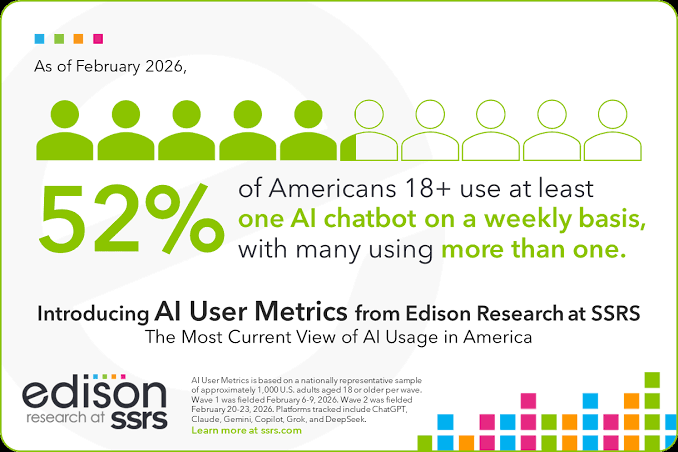
About half of the people asked in a new nine-country survey use an AI chatbot every week. Very few of them use it to keep up with the news.
The audience survey was published on Wednesday, 11 November. According to a summary from the AI news tracker AI Weekly, 51% of respondents said they use standalone AI tools such as ChatGPT, Claude or Gemini at least once a week. In the United States the figure was 49%, slightly below the overall average.
The share of people who said they use AI specifically to get news was 9%. That is up from 6%, but it is still a small fraction of the weekly user base.
Use for information jumps
The survey’s biggest change is in how often people turn to generative AI for general information. The summary puts weekly use of generative AI for information at 38%, up from 24% in 2025.
That is a 14-point rise in about a year, or roughly a 58% relative increase. The news figure grew by 3 points over the same comparison. People appear to be asking chatbots for facts, explanations and answers far more often than before. Asking them what is happening in the world has grown much more slowly.
The summary does not say what people use AI tools for beyond the information and news categories. It also does not say which tools drove the increase.
Search puts AI in front of people anyway
For many people, contact with AI does not depend on opening a chatbot at all. According to the summary, 57% of respondents said they had come across AI-generated answers in search results in the previous week.
That number is higher than the 51% who said they actively use standalone AI tools weekly. The likely reason is that search engines now place AI-written summaries above or next to traditional results. People see these answers whether or not they would choose an AI tool themselves.
This matters for publishers. Someone who would never ask a chatbot about a breaking story may still read an AI-generated summary of it at the top of a search page. On these figures, the 9% who say they use AI for news probably understates how often AI shapes what people learn about current events.
What the figures do and don’t show
The summary reviewed for this article gives the main percentages but leaves out several details readers would need to judge them. It does not name the organisation behind the survey, list the nine countries, give the sample size or explain how respondents were recruited. It also does not say whether “weekly use” means at least once a week or a self-reported habit. Those details could change how the numbers should be read.
The comparison years also need care. The summary compares 2026 with 2025 for information use. It gives an earlier figure of 6% for news use without saying which year that came from. Readers should treat the size of the year-on-year changes as indicative until the full report and its methodology can be checked.
With those limits in mind, the main findings from the summary are:
- 51% of respondents across nine countries use standalone AI tools weekly; 49% in the US.
- 38% use generative AI for information weekly, up from 24% in 2025.
- 57% saw AI-generated answers in search results in the past week.
- 9% use AI specifically for news, up from 6%.
A gap between habit and trust
The survey summary does not explain why news lags behind other uses. Several explanations are possible, but the published figures do not test any of them. People may prefer to get news straight from outlets they know. They may doubt that chatbots are reliable on fast-moving events. Or they may simply not think of an AI assistant as a place to find news.
What the figures do show is that weekly AI use is spreading. More than half of respondents use these tools every week, and use for everyday information has grown quickly. AI-written answers also now reach a majority of people through search alone. News remains a small slice of that activity.
For news organisations, the two sets of numbers point in different directions. Few people choose AI tools as a source of news. But AI summaries in search results increasingly sit between readers and the original reporting. If the full report includes country-by-country breakdowns and data on trust, it should show more clearly whether the 9% figure is a ceiling or an early stage.