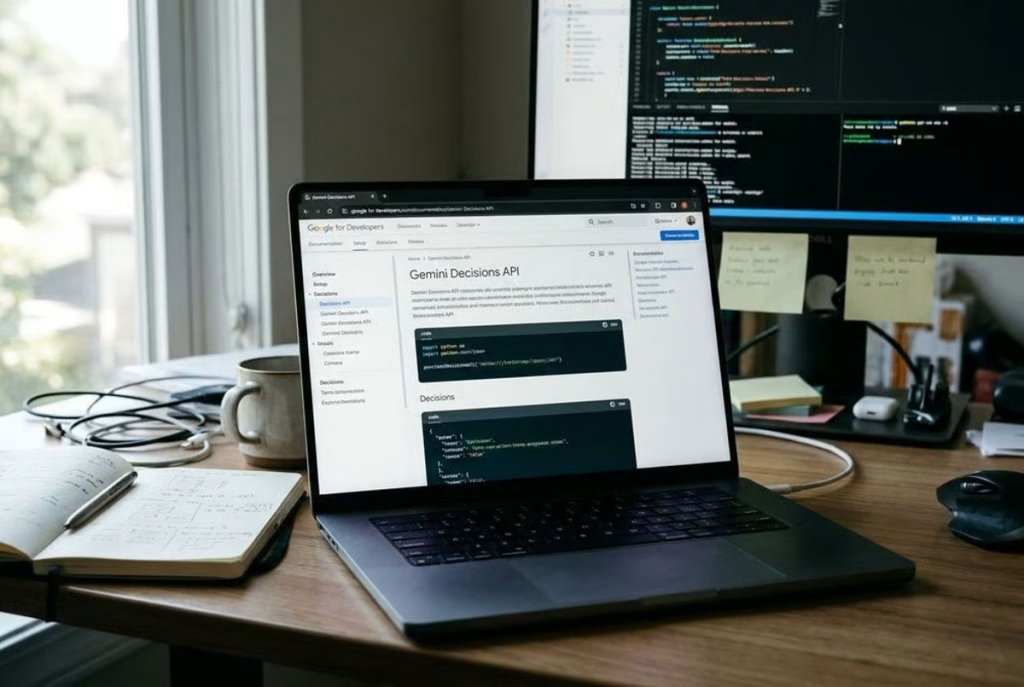
Most AI models answer in sentences. Google’s newest release only picks an answer.
On Thursday, 12 November, Google released the Gemini Decisions API. According to the AI newsletter This is not Average, it can answer up to 1,000 yes-or-no or multiple-choice questions in about a quarter of a second. It does this instead of writing out a full response. The Deep Gains morning brief called it a “decision-only” model.
Google DeepMind also released two other products that day: Gemini Robotics 2.5 and AlphaGenome 2. That was reported by Deep Gains and by The Neuron’s daily digest.
Answers without the essay
The idea is easy to follow. A lot of business software doesn’t need a model to explain itself. It needs a quick label. Is this message spam? Which of four categories does this ticket fit? Should this request be approved?
A general chatbot can do these jobs, but it produces text that someone then has to parse, and that takes time. The reports describe a product that limits the output to a fixed set of choices so it can return results much faster.
The coverage available so far does not give some important details:
- pricing
- which Gemini model the service runs on
- how accurate it is compared with Google’s general-purpose models
- whether the quarter-second figure covers a full batch of 1,000 questions or a narrower case
Until Google publishes technical documentation or benchmarks, the speed claim should be read as reported, not independently tested.
Two DeepMind releases the same day
Gemini Robotics 2.5 is a new version of DeepMind’s model line for robots. AlphaGenome 2 follows DeepMind’s earlier AlphaGenome model, which applied AI to genome research. The newsletters reported that both shipped on Thursday. They did not describe what changed from earlier versions, and this article does not try to fill in those details.
Taken together, the three releases show Google working on several fronts at once: developer tools, robotics and life sciences.
A crowded week for AI releases
Google’s launches came during a busy few days for AI products. According to Deep Gains, OpenAI introduced a feature called Businesses in ChatGPT. Alibaba opened a closed preview of Qwen4-Max, and Nous Research released a fine-tuned model called Arete-27B. The Neuron reported that Databricks launched an always-on business assistant.
Not every planned release arrived. This is not Average noted that Grok 4.8, which had been promised for Tuesday, 10 November, still had not shipped as of Thursday.
The bigger story in AI that day was in the markets. This is not Average reported that Nvidia’s board accepted chief executive Jensen Huang’s resignation and named chief financial officer Colette Kress interim CEO. The early reports did not agree on the details. Deep Gains described the board as preparing to remove Huang and said shares fell more than 8 percent after hours. This is not Average said the stock fell about 12 percent when trading opened.
What to watch
For developers, the open question is how well the Decisions API performs in practice. Speed only helps if the answers are reliable, and a system that gives fixed answers can still be confidently wrong. Google has not yet released public figures on how often its choices are correct.
The other test is cost. Classification and routing tasks often run in very large numbers. Whether this product makes sense compared with smaller, cheaper models will depend on pricing that Google had not announced in the coverage available as of Friday.