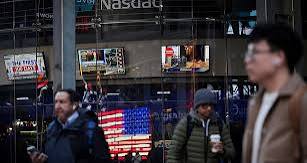
One day of gains lasted one day. On Thursday, a sell-off in artificial intelligence stocks wiped out Wall Street’s best session in three months. The S&P 500 fell 4.4%, according to the Associated Press. That was its worst day since President Donald Trump’s “Liberation Day” tariffs shook markets in April 2025.
The Dow Jones Industrial Average dropped 1,833 points, or 3.4%, and settled at 51,523, CNBC reported. The Nasdaq composite fell 5.5%. The S&P 500 closed at 7,354, per CBS News.
What got hit
The losses were concentrated in companies tied to the construction of AI data centers. Advanced Micro Devices fell 17.3%. CoreWeave, which rents out AI computing power, lost 9.8%. GE Vernova, which supplies equipment that helps power data centers, dropped 7.5%, the AP said.
Nvidia is the biggest weight on the S&P 500. It had already lost 3.2% on Wednesday. Reports differ on Thursday’s move: the AP’s final story put it at about 8%, while CBS News said 9.2%. CNBC reported that Broadcom fell about 10% and Oracle nearly 7%.
The Nasdaq closed about 11.9% below its October record, according to TheNextWeb. That puts it in a correction, the term for a fall of more than 10% from a peak. The same outlet said the Nasdaq-100 lost roughly $2.3 trillion in market value in the session.
Why the midterms matter here
Several outlets tied the move to Tuesday’s midterm elections. Democrats won sweeping victories, and investors are weighing whether a Democratic-controlled Congress could restrict or slow data center construction. CBC reported that worries about possible moratoriums on data centers were pressuring AI stocks around the world.
The logic is simple. Fewer data centers would mean fewer purchases of AI chips, and less demand for electricity and related equipment. The AP noted that this demand is driving much of the current U.S. economic activity.
Analysts also saw weakness building before the vote. E*TRADE’s Chris Larkin said there were “visible cracks” in the AI ecosystem even as the market rallied on Wednesday, according to CBS News. Truist’s Keith Lerner told CNBC that the tech sell-off had grown large enough to feed into the wider market.
TheNextWeb also linked the drop to late-October earnings reports that raised questions about how quickly AI spending will pay off. That is the outlet’s framing, and the sources do not say how much weight investors gave it.
Global and political fallout
The damage was not limited to New York. Overnight in Asia, chip-related shares fell sharply in Tokyo, according to XTB. Advantest lost about 11.7%, Lasertec about 11.8% and Tokyo Electron nearly 10%. The AP reported that Japan’s Nikkei fell more than 6% after the Wall Street drop. In Canada, the S&P/TSX composite fell by more than 700 points, BNN Bloomberg reported.
Trump blamed the Democratic wins for the drop. On Truth Social he warned that Americans’ 401(k) accounts had been hurt, Fox Business reported. The sources reviewed do not show that the election is the only cause. Investors were also dealing with high valuations and the earnings questions mentioned above.
What it means for ordinary savers
AI-linked companies are now some of the largest in the stock market. That means they make up a large share of the index funds in many retirement accounts. A hit to a handful of chip and cloud stocks therefore shows up in a typical 401(k) or pension fund, even for people who own no individual shares.
There is one possible offset. CNBC said the equity sell-off eases pressure on the Federal Reserve to raise interest rates at its final meeting of the year in December. Higher rates have pushed up borrowing costs, so a pause would matter to anyone with a mortgage or a variable-rate loan. The sources did not say whether the Fed would change course.
The volatility itself was also notable. CNBC reported that the Cboe Volatility Index, Wall Street’s “fear gauge,” rose as the selling picked up. Yahoo Finance quoted one strategist as saying it was the biggest one-day jump in that gauge in more than two years.
Volatility can reverse quickly. XTB noted that sharp market drops can unwind fast, and a single headline can change the mood. Investors will be watching for any sign of how Congress plans to treat data centers, and whether the companies building them change their spending plans.
For now, the broad market’s post-election gains are gone. The AI trade that powered much of the year’s rally is under strain.