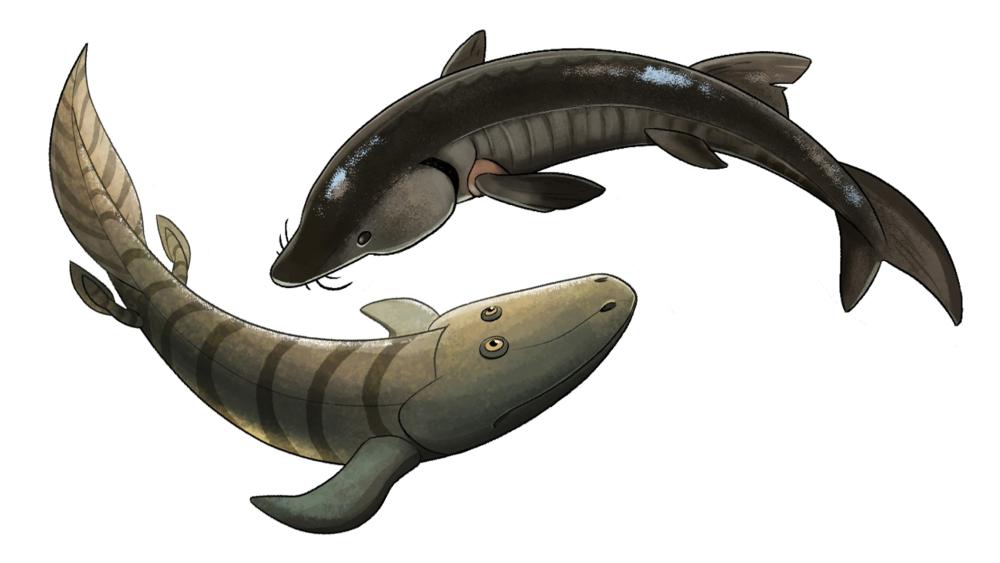
The first animals to leave the water had necks, but they may not have been able to do much with them. A new modelling study suggests that early four-limbed creatures, which lived about 380 million years ago, could hardly turn their heads at all.
The work was published on 14 October in the journal Nature and is now getting wider attention through a Penn State release that ScienceDaily carried this week. It questions a textbook explanation that has lasted for decades. That explanation says the neck evolved so that early land animals could look around without moving their whole bodies.
A neck that didn’t bend
In fish, the shoulder bones are attached directly to the skull. When the head and shoulders separated, a distinct neck appeared, and many scientists assumed this gave the animals much more freedom of movement. In shallow water or on land, being able to look down or sideways could have helped them find food and avoid predators.
The new models point to a different picture. Even after the skull separated from the shoulder girdle, the backbone in that region seems to have been too stiff to allow much movement. According to Penn State’s account of the research, the muscles, the skin and, in some species, small bones set into the skin may have made the neck stiffer still.
“We know that tetrapods did eventually gain higher neck mobility,” said Dana Korneisel, the paper’s first author, in the Penn State release. Korneisel is a postdoctoral researcher at Uppsala University in Sweden and was formerly at Carleton University in Canada. Her point is that the flexible necks seen in many land animals today came later and were not present at the start.
Why sturgeon?
The main obstacle was missing tissue. Early tetrapods had a notochord, a flexible rod of tissue that runs along the back. According to coverage of the study, their notochord was much larger than their individual vertebrae. Soft tissue like this is almost never preserved in fossils, so researchers could see the bones but not the material between them that controlled how much the spine could bend.
The team used the sturgeon to fill that gap. This modern fish has a backbone built much like those of early tetrapods. According to Phys.org, the researchers dissected sturgeon spines and tested them on a universal testing machine, which bends and twists samples while measuring the force needed. They spent three days testing batches of three or four fish. First they removed the whole backbone, then they cut out sections of the notochord so that each tissue could be measured separately.
Korneisel said she had not expected much stiffness. In the release, she said that handling the sturgeon spines had given her the impression that the tissue was not very stiff. The measurements suggested otherwise once they were applied to fossil animals.
The researchers put the sturgeon measurements into computer models of several fossil species. These included Tiktaalik roseae, a fish about 375 million years old that had features found in later land animals. Phys.org reported that the models went beyond checking whether bones would collide. They calculated the force needed to bend the spinal column and estimated how much muscle could have fitted around the neck to provide that force.
The fossil at the centre
Tiktaalik was found on Ellesmere Island in Nunavut, in Canada’s Arctic, and was described in 2006. According to CBC reporting carried by Yahoo, researchers have pointed to it ever since as the earliest known example of an animal whose skull was separate from its shoulders. That made it a key example for the idea that necks evolved to improve head movement.
Korneisel told CBC that little earlier research had looked at how far early tetrapods could actually bend or twist their necks. She said the project was helped by an earlier 3D reconstruction of Tiktaalik‘s neck region made by co-author Tom Stewart, an assistant professor of biology at Penn State.
These animals lived during the Devonian Period, about 420 million to 360 million years ago. Tetrapods are the four-limbed vertebrates and their descendants, a group that today includes mammals, birds, reptiles and amphibians. Changes to the skeleton during this period can still be seen in human bodies.
If not for looking around, then what?
The study does not question that necks appeared during the move from water to land. It questions why. If the first necks were stiff, then better head movement probably was not the main reason for separating the head from the shoulders.
The paper does not settle what that reason was. Some coverage of the work suggests that the first necks may have had more to do with the early stages of walking than with looking around. The researchers describe this as a possibility, not a conclusion.
The results also depend on an assumption: that sturgeon tissue behaves enough like the soft tissue of animals that died hundreds of millions of years ago. The team chose the sturgeon because its spine is built in a similar way. Still, fossils cannot directly confirm how stiff a notochord was.
Korneisel told CBC that she hopes to test other well-preserved early fish. She said this could show more about how Tiktaalik and its relatives moved their whole bodies, not just their heads.