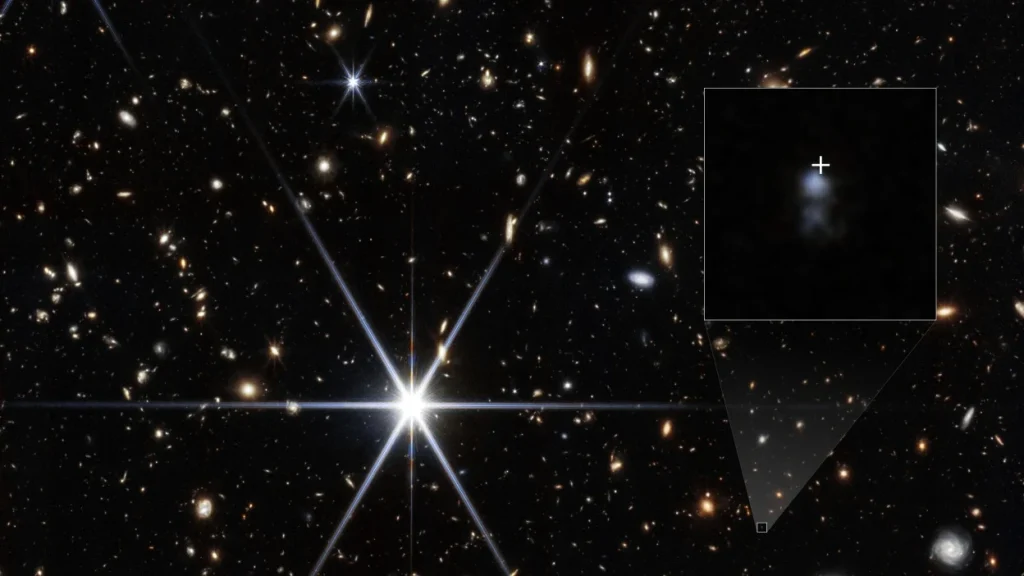
A radio flash that lasted only a few milliseconds has now been traced to a galaxy so far away that its signal left when the universe was roughly 3 billion years old. Astronomers say it is the most distant fast radio burst ever detected.
The burst is catalogued as FRB 20240304B.
The study appeared on Thursday, 8 October, in the journal Science
, and
the detection more than doubles the previous distance record for these events.
A flash with no visible source
Fast radio bursts are brief, intense pulses of radio waves.
Thousands have been found, but because they last only milliseconds, they are hard to study and their origins remain unclear.
This one was first caught by MeerKAT,
an array of 64 radio telescopes in South Africa.
According to the Brighter Side of News,
the MeerTRAP project detected it on 4 March 2024.
MeerKAT gave a very precise position on the sky. That was not enough on its own.
Powerful ground-based telescopes looked at that spot and found nothing. The researchers told Live Science it
looked like empty sky
. The likely explanation was a host galaxy too faint for those instruments to see.
Webb finds the home address
That is where the James Webb Space Telescope came in. According to DIY Photography’s account of the work,
Webb’s NIRCam instrument detected the host galaxy, and its NIRSpec spectrograph then analysed the galaxy’s light.
The spectrum gave a redshift of 2.148. Redshift measures how much light has been stretched by the expanding universe, and this value places the galaxy in a period called cosmic noon, about 3 billion years after the Big Bang.
For comparison,
previously reported FRB host galaxies had reached a maximum measured redshift of 1.016.
Reports differ a little on the distance. Live Science says more than 10 billion light-years, while Space.com puts the host galaxy around 11 billion. Both are describing the same object. The gap likely reflects how light-travel distance is rounded.
A surprise about the source
The host is not a large, mature galaxy. Webb showed
a tiny, star-forming dwarf galaxy.
The Brighter Side of News reports that
a young, actively star-forming host favors a rapidly formed source, such as a magnetar, over long-delay merger models.
A magnetar is a neutron star with an extremely strong magnetic field. Merger models would require more time for the source to form. That is an interpretation of one burst, not a settled answer for all FRBs.
Space.com reports that the team was surprised by the source. It also notes that FRBs can act as messengers. As the pulses travel,
they pass through gas and dust in galaxies and through the space between them
, so they carry traces of that material.
Team co-leader Manisha Caleb of the Sydney Institute for Astronomy said in a statement,
“This is an extraordinary glimpse into the distant universe.”
The researchers used the burst’s signal to learn about the matter it crossed over billions of years. Space.com adds that this could eventually reveal details of about 11 billion years of cosmic evolution.
What is still open
One burst does not explain the whole population. Whether most FRBs come from young magnetars, or whether several kinds of sources exist, will need more distant events with identified host galaxies. The pairing used here, a radio array to pinpoint the position and Webb to find the faint galaxy, gives astronomers a template for doing that.