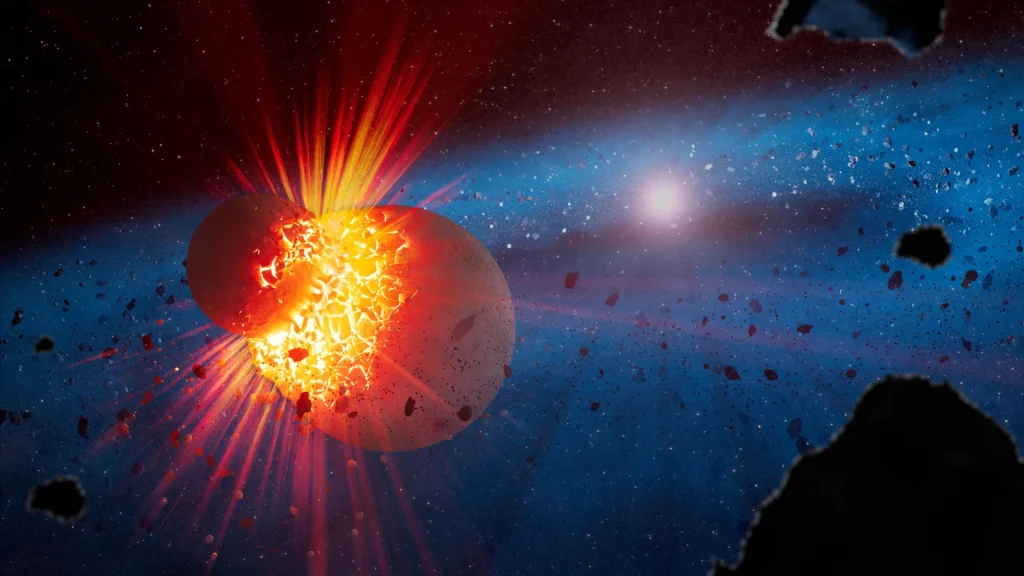
Around some young stars, whole worlds appear to be getting smashed apart. Astronomers using NASA’s James Webb Space Telescope say the dust left behind can show how big those collisions were.
The finding, released by NASA on 7 October 2026, rests on a study of 21 “extreme debris disks”. These are rare clouds of warm dust around young stars, thought to be the debris of planetary impacts.
Why these disks matter
One of the pivotal events in the early solar system was a collision between the young Earth and a Mars-sized body called Theia, according to NASA’s summary. The impact likely vaporized huge amounts of rock and flung material into space. Some of it later gathered to form the Moon.
Nobody can watch that happen here. But similar events may be occurring around other stars now, and studying them could show how rocky planets form and change.
What the team looked at
Extreme debris disks are uncommon, but the team assembled a sample of 21, according to Phys.org’s report on the work. Five came from archival data from the Spitzer Space Telescope. The other 16 came from Webb, including 12 newly observed disks and follow-up observations of four of Spitzer’s.
Mid-infrared spectra from the two telescopes showed that the disks share three traits. Their dust grains are smaller than those in protoplanetary or ordinary debris disks. They hold a lot of warm dust. And their brightness varies irregularly.
Silica as a clue to impact size
The disks split into two groups by composition. About one-third are rich in silica. The researchers interpret these as the product of high-energy impacts between Mars-sized bodies, in which a large share of the material is vaporized.
The other two-thirds are poor in silica. That points to smaller-scale events, such as grazing collisions between Moon-sized objects.
Age also differs. Silica-rich disks turn up only around stars younger than 300 million years. Silica-poor disks appear across a wide range of ages and often vary more in brightness.
A match with solar system timing
Simulations suggest that terrestrial planets such as Earth should form within the first few hundred million years of a planetary system’s life. That fits the ages of the silica-rich disks, according to the report. In other words, the biggest smash-ups seem to occur at the stage when rocky planets are being assembled.
NASA’s account adds that the movement of growing bodies can disturb the orbits of smaller objects. That sets off catastrophic collisions and produces short periods heavy with dust, like those seen in extreme debris disks.
What is still open
The impact sizes are inferences drawn from dust chemistry, not direct observations of the collisions. The sample is small, and the coverage I found does not say how the results might change with more disks. The work does not show that any of these systems will end up with a moon-forming impact of its own.
Still, linking a dust signature to the scale of a collision gives astronomers a measuring tool. It lets them compare other star systems with the violent youth thought to have shaped Earth and the Moon.