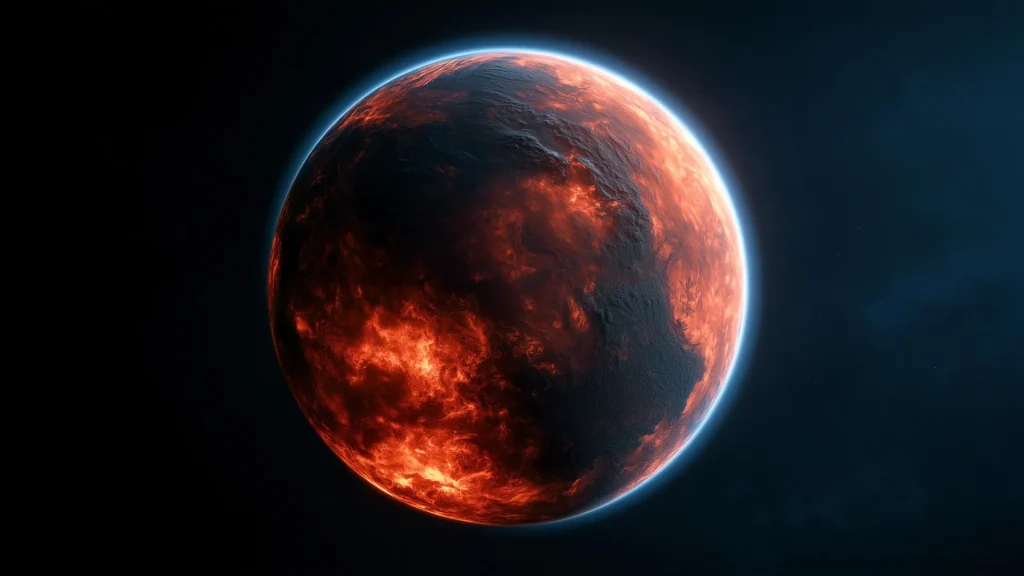
A planet that completes a full orbit in one Earth day, baked by its star, should have lost its air long ago. The James Webb Space Telescope now suggests that at least one such world has kept its atmosphere.
The planet is HD 3167 b, a rocky super-Earth.
A team led by University of Chicago scientist Brandon Park Coy reports evidence of an atmosphere around it in The Astrophysical Journal Letters.
The planet lies 154 light-years away in the constellation Pisces and is classed as a “lava world.”
Why an atmosphere is a surprise
The expectation is simple. The closer a rocky planet sits to its star, the more punishment it takes. Stellar wind strips gas away, and the star delivers more high-energy light.
Edwin Kite, a UChicago associate professor of geophysical sciences and co-author, put it this way:
“the closer a rocky planet orbits its star, the harder it should be to have an atmosphere.”
He added that many lava worlds seem to have one anyway, according to the university’s release.
HD 3167 b is not the first. The university’s account says researchers have added another world to a short list of lava worlds with atmospheres. Webb has recently produced similar hints elsewhere.
A study of TOI-561 b, an ultrahot and very old planet, was described as the strongest evidence yet on a hot rocky world for air that is not just leftover hydrogen and helium.
What the researchers say it means
The planets are far too hot for life. Kite said as much. His argument is that studying them says something about the processes that matter for other rocky worlds.
That includes the early Earth. The release notes that the findings could help explain how rocky planets hold on to atmospheres, and what the young, molten Earth may once have looked like.
Co-author Tim Lichtenberg, of the University of Groningen, has pointed out that every planet in our solar system was once molten like TOI-561 b.
That comment came in coverage of a different planet, but the same reasoning applies here.
A secondary summary of the HD 3167 b result says the detection came from a secondary eclipse, when the planet passes behind its star, and points to a silicate-rich composition. The fuller details sit in the paper and the university’s question-and-answer with Coy. Readers who want the exact measurements should check the journal article itself.
Still an open question
“Strong evidence” is not confirmation. Webb sees these planets only as faint changes in light, and a planet’s temperature and brightness can be read in more than one way. The team’s claim rests on its interpretation of the data. Other astronomers have not yet weighed in publicly in the sources reviewed here.
The composition of such atmospheres is also unsettled. In the TOI-561 b case, scientists did not know what the air was made of or how it survived so long. Lichtenberg suggested it probably bubbled up from the planet’s magma ocean. Whether HD 3167 b’s atmosphere has a similar origin is not established in the material available.
The planet’s size and heat make it a useful test case. If several lava worlds keep their air despite the conditions, the old rule that small, warm planets lose their atmospheres will need revising for planets this close to their stars.