South Korea’s stock market had a rough Tuesday.
SK Hynix shares tumbled more than 10% in Seoul, Samsung Electronics dropped 7.4%, and the benchmark Kospi fell 5.5%
, according to Quartz, citing CNBC. The trigger was a announcement from a Chinese company most investors cannot even buy.
What CXMT said
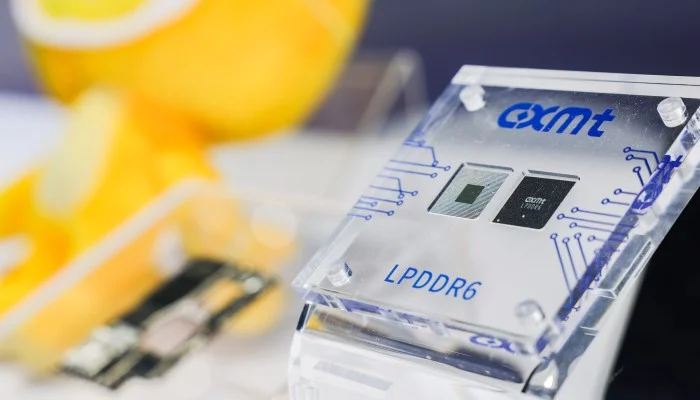
ChangXin Memory Technologies, or CXMT, is a Chinese chipmaker not listed in the US. According to 24/7 Wall St., it said it has made significant progress on a new cell design that increases storage density.
CXMT’s president, Cao Kanyu, presented at an industry event in Shanghai over the weekend.
Quartz reported that CXMT plans to release a server memory chip using a so-called 4F square design by year-end. Samsung and SK Hynix have both been exploring the same architecture, the outlet said.
Server memory matters because it is where AI data-centre building has driven the strongest demand and where prices have held up best, according to 24/7 Wall St.
How far the shares fell
The selling began in the US on Monday. Quartz reported that Micron was down about 3% at $998.15 that day, heading for a third straight losing session. SanDisk fell 5.7%, while Seagate and Western Digital lost 3.4% and 2.3%.
On Tuesday the damage spread. Quartz said Japan’s Nikkei 225 dropped 1.8%. In Europe, ASML was down 3.3%, and STMicroelectronics and Infineon each lost 5%. CNBC reported that Micron slipped a further 3.62% on Tuesday, and 24/7 Wall St. had it down about 5% at $942.21 in morning trading.
Micron is still far ahead for the year.
Quartz said it was up 261% through Friday’s close.
Its adjusted gross margin reached 87% last quarter, up from 45.7% a year earlier, according to 24/7 Wall St.
Is the reaction too big?
Analysts are divided on how much the news itself matters. Most see CXMT as behind the US and South Korean leaders, Quartz reported. Phillip Wool of Rayliant Global Advisors called the announcement meaningful for China’s chip industry. But he said the size of the sell-off was out of proportion to the near-term threat. His reasoning: CXMT has not shown it can build at volume and holds a fraction of Samsung’s and SK Hynix’s market share.
Another view came from Vey-Sern Ling of UBP, speaking to CNBC. He said investors are looking for excuses to take profits in AI-related stocks that have outperformed this year, memory shares especially.
CNBC also pointed to a second worry: the CEOs of Intel and Broadcom have warned that access to capital could become a major obstacle for the AI boom. A report on a separate website, KuCoin, said Goldman Sachs had flagged a possible profit peak. Some of the sources vary on the details, and the causes of the fall are not settled.
The drop was also not confined to companies that compete with CXMT. 24/7 Wall St. noted it is harder to explain why SanDisk, a flash storage company with no server memory exposure, fell almost as fast. That suggests a broad de-risking rather than a reaction to one product.
Why it matters beyond trading screens
Memory makers have become some of the market’s biggest winners from AI spending, and large index funds and pension portfolios hold them. A sharp reversal in a few heavyweight stocks can dent retirement savings, particularly in markets like South Korea, where Samsung and SK Hynix carry heavy weight in the main index.
It also bears on prices. High memory prices feed into the cost of servers, and eventually of devices and cloud services. A credible new competitor, if one emerges, would tend to push those prices down over time. That is a long way off, and CXMT has yet to ship the product it described.
For now, the broader US market looks steadier than the chip sector. 24/7 Wall St. showed the S&P 500 ETF nearly unchanged on Monday while memory names slid.