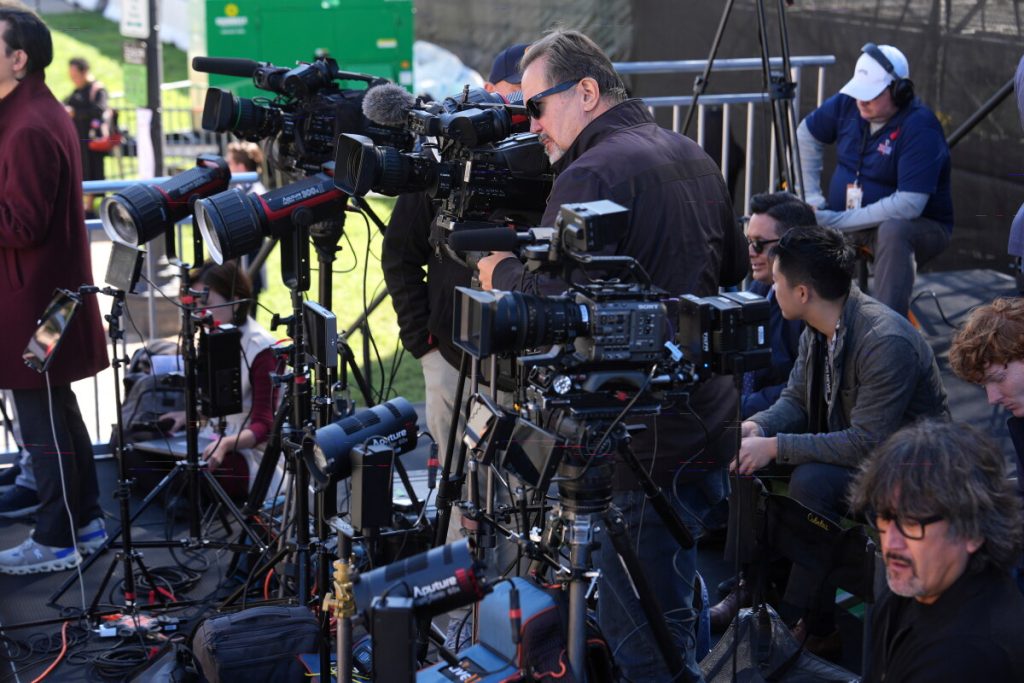
The Justice Department is investigating whether the five television networks that make up the White House press pool broke antitrust law when they briefly stopped covering President Donald Trump last month. The department confirmed the inquiry on Saturday, 10 October.
The networks involved are ABC, CBS, CNN, Fox News and NBC. They have shared pooled video of the president for decades, and local stations and news sites around the world draw on that footage.
What the department says
According to the Associated Press, Justice Department spokeswoman Emily Covington said group boycotts among business competitors can violate the law. CNN reported her statement in more detail: the Antitrust Division, she said, is “simply investigating” whether the organizations violated antitrust statutes.
CNBC reported that the department is looking at the Sherman Act, an 1890s law that bars certain agreements that unreasonably restrain trade. The act has rarely been applied to news organizations over their coverage decisions.
How the dispute began
The pool halted its coverage of Trump after the administration barred CNN, MS NOW and Politico from the White House. The AP described the ban as an extraordinary escalation in Trump’s efforts to restrict outlets he finds insufficiently supportive.
CNN, MS NOW and Politico sued. According to the AP, the ban was lifted after a judge gave the three outlets a reprieve, which remains in place until Tuesday, 13 October. CNBC reported that the judge restored access on due-process grounds, but that the order did not cover later exclusions from Air Force One travel. Television pool coverage of the White House has since resumed.
NBC News noted that the lawsuit, which is still moving through federal court, has implications for the pool system that journalists in the United States and abroad rely on to report on the presidency.
Critics call it retaliation
Bruce Brown, president of the Reporters Committee for Freedom of the Press, said the investigation “appears to be a pretext” for obtaining records from the networks about how they cover daily White House events. He said coverage decisions are protected by the First Amendment and called the probe another attempt to intimidate journalists, according to CNN.
Jose Zamora, regional director for the Americas at the Committee to Protect Journalists, also criticized the decision, the AP reported.
Jonathan Kanter, who led the Antitrust Division under President Joe Biden, told CNN that any such claim would run into Supreme Court precedent that protected civil rights-era boycotts as speech. He argued that pool members acting together in response to what they see as a First Amendment violation is no more an antitrust problem than reporters forming the pool in the first place.
What is not yet known
The reports do not say what the department has requested from the networks, whether subpoenas or civil investigative demands have been issued, or how long the inquiry might last. ABC, CBS, CNN, Fox News and NBC either declined to comment or did not respond to requests when CNN asked on Saturday night. The AP said it also sent messages to the five outlets seeking comment.
The department’s position, as stated, is narrow: a joint decision by competitors to stop providing a service can raise legal questions regardless of the subject matter. Critics respond that the pause was a reaction to the government’s own decision to exclude certain outlets, and that the legal theory stretches antitrust law into newsgathering.
The next marker is the court calendar. The temporary order protecting the access of CNN, MS NOW and Politico is due to lapse on 13 October unless the judge acts further.