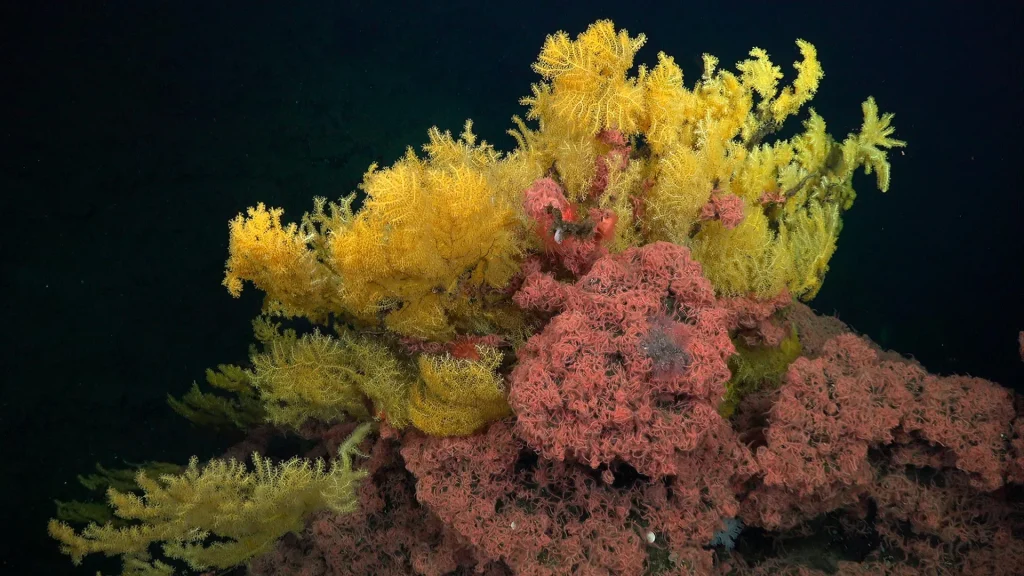
Naming a new species is routine for taxonomists. Naming a new family is not. Yet that is what a team of researchers has done for a bright yellow coral from the deep Pacific off Costa Rica, after its anatomy and genes would not fit anywhere in the existing coral classification.
According to a release from Pensoft Publishers, the findings appear in the open-access journal ZooKeys. The coral is called Laurinque elenya. It sits in a new genus, Laurinque, and a new family, Laurinqueidae, as reported by The Brighter Side of News.
A yellow tree on a carpet of brittle stars
The coral has a branching, tree-like shape. Some colonies grow more than a metre tall, according to the release. They were found between 360 and 529 metres below the surface.
The colonies rose from rocky seamounts that were almost completely covered with brittle stars, SciTechDaily reported. The golden branches stood above the crowded seafloor.
That scene shaped the name. The genus name comes from a word meaning “golden tree” in Quenya, an Elvish language invented by J.R.R. Tolkien. The species name, elenya, is tied to the stars, a nod to the brittle stars below. ScienceDaily’s summary of the release translates the full name as “golden tree of the stars.”
How the specimens were collected
The samples came from two expeditions, in 2019 and 2023. Both used research vessels operated by the Schmidt Ocean Institute: Falkor and, later, Falkor (too). Specimens were collected with the remotely operated vehicle SuBastian.
The surveys covered seamounts near Isla del Coco and along Costa Rica’s Pacific margin. A seamount is an underwater mountain that does not reach the surface. Such features often host dense communities of corals and other animals that filter food from passing water.
Why it needed a new family
Placing the coral on the evolutionary tree turned out to be harder than expected, according to SciTechDaily. The researchers sequenced several genes, and the results did not all agree. Some analyses gave a weaker, less certain placement near other gorgonian groups.
A larger analysis using hundreds of genes was clearer. The Brighter Side of News reports that it placed the coral closest to a known family called Eunicellidae, yet distinct enough to stand apart. Together with its physical features, that was the basis for creating Laurinqueidae.
The coral is a gorgonian octocorral, a group often called sea fans or sea whips. Octocorals have polyps with eight tentacles. Many form branching colonies anchored to rock.
What it adds
The find joins a growing list of species not previously documented on Costa Rica’s seamounts, SciTechDaily noted. It also underlines how little of the deep ocean has been explored. The deep sea covers roughly two-thirds of Earth’s surface.
The Brighter Side of News says the discovery could help scientists identify vulnerable coral habitats on Costa Rica’s Pacific seamounts. Deep-sea corals grow slowly and can be damaged by fishing gear and other disturbance, so knowing what lives where is a first step toward protecting it. The sources I reviewed did not describe any specific protection measures tied to this finding.
The articles I could read give no population estimate for the coral, and do not say whether it lives anywhere beyond the seamounts surveyed. Those questions remain open. For now, the species is known from the two expeditions that found it.
The result also shows why gene sequencing now matters so much in classification. Appearance alone can mislead in corals, where colonies from different lineages can look alike. Here, the genetic evidence was what showed the coral belonged to a lineage of its own.