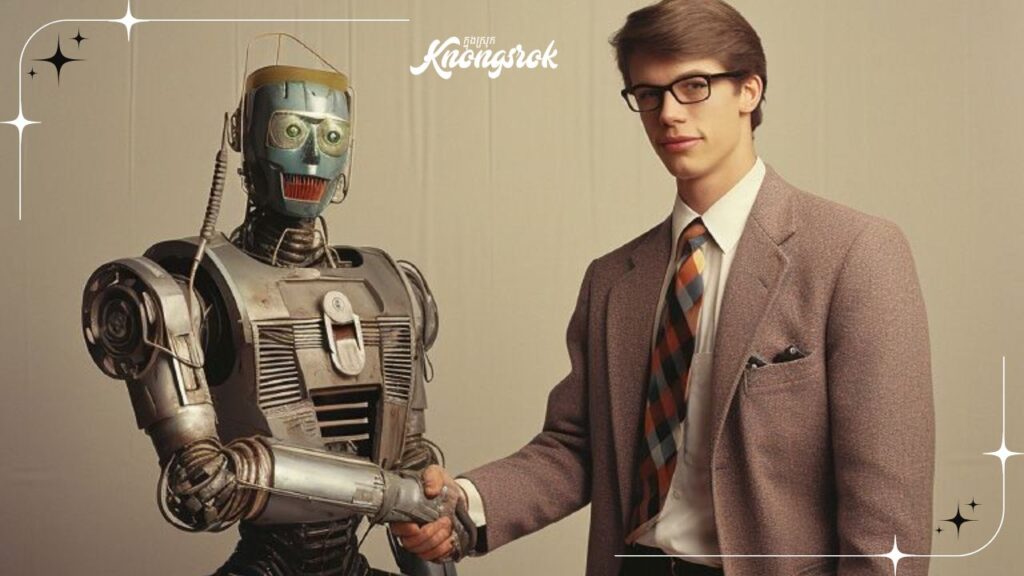
The rise of artificial intelligence has sparked one of the greatest philosophical and scientific debates of our time: Can machines ever truly think like humans? As AI systems write poetry, diagnose diseases, and debate with us online, the line between programmed intelligence and organic thought continues to blur.
But while AI can now mimic many functions of the brain—language, logic, even creativity—does that mean it “thinks”? Or are we just seeing the most advanced simulation ever created?
What It Means to “Think”
To understand the question, we must define what “thinking” means. Human thought is complex—it includes memory, emotion, judgment, intuition, and consciousness. We don’t just process data—we assign meaning, reflect on choices, and experience self-awareness.
In contrast, AI operates through algorithms, probability, and pattern recognition. It can produce content that sounds intelligent, but it lacks the context of lived experience.
So, the real question is: Is intelligence just the ability to produce useful outputs—or does it require awareness?
What AI Can Do (Today)
In 2025, AI has already achieved feats once thought impossible:
-
Language fluency: Tools like ChatGPT can hold multi-step conversations, explain complex topics, and even mimic humor or empathy.
-
Image and video generation: Systems like Midjourney and Runway can create original visuals and films from just a few words.
-
Medical breakthroughs: AI assists in cancer detection, drug research, and predictive diagnostics.
-
Creative tasks: AI now writes novels, composes music, and even codes entire apps.
These systems process trillions of data points in seconds, learning patterns faster than any human brain. But does that make them “smart”?
The Imitation Game: Can AI Fool Us?
Alan Turing, the father of modern computing, proposed a simple test: if a machine can carry on a conversation indistinguishably from a human, it could be said to “think.” This became known as the Turing Test.
Many modern AIs can pass basic forms of the test. People interact with bots daily without realizing it. Yet these systems don’t understand—they simulate understanding. Ask a chatbot about love or grief, and it can give a poetic answer. But it doesn’t feel anything.
It’s like watching a puppet show. The illusion is compelling, but the strings are still there.
Where AI Still Falls Short
Despite impressive progress, AI lacks several uniquely human qualities:
-
Emotion: AI can describe feelings but doesn’t experience them.
-
Intuition: It relies on data, not “gut instinct.”
-
Common sense: AI still struggles with basic reasoning in unfamiliar contexts.
-
Self-awareness: AI doesn’t know it’s thinking. It has no inner voice or consciousness.
No matter how advanced the neural network, it doesn’t care about its answers. It has no goals, no fears, no curiosity. It calculates, but it doesn’t contemplate.
Philosophy vs. Code: Can We Build Consciousness?
Philosophers have long debated whether the mind is just a biological machine—or something more. If thoughts arise from patterns of neurons, could similar patterns in silicon produce awareness?
Some argue that consciousness may emerge from complex systems once they reach a certain threshold. Others say that true experience—what it feels like to be “you”—can never be replicated by a machine.
Either way, we haven’t reached that level yet. Today’s AI is a powerful tool, not a being.
A Future of Partnership, Not Rivalry
Rather than fearing AI as a replacement, we should see it as a collaborator. AI can amplify our intelligence, automate tedious work, and unlock new forms of creativity. But it still needs human guidance, purpose, and morality.
In the coming decades, we may see hybrid systems: humans augmented by AI, not outpaced by it. The mind-machine boundary may blur—but human values must lead the way.
Conclusion: More Brain Than Mind
AI today is brilliant at mimicking thought—but thinking requires more than calculation. It involves meaning, emotion, and experience. For now, machines don’t think like us. They don’t want anything. They don’t feel the weight of choice.
And perhaps that’s a good thing.
As AI becomes a permanent part of our lives, the goal isn’t to make it human. The goal is to let it help us be more human—more curious, creative, and connected.