Two parts of the US financial system are sending opposite signals. Stocks are at record highs. Borrowing costs are at levels that haven’t been seen in years.
The Nasdaq closed at a fresh record on Monday, led by artificial-intelligence-linked shares, according to CNBC. At the same time, the 10-year Treasury yield rose more than 3 basis points to about 5.31%. The 30-year yield rose to about 5.66%. CNBC reports that both have reached multiyear highs in recent weeks, as traders worry that inflation will make the Federal Reserve hold rates high for longer.
A bruising quarter in the bond market
NBC News reported on 1 October that Treasury yields on the most closely watched bonds had reached their highest levels since 2002. It said the 10-year yield touched 5.34% and the 30-year reached 5.69%. Over the three months to the end of September, the 10-year yield had its biggest quarterly jump since 1994, NBC said.
Not all outlets date the peak the same way. U.S. News & World Report describes 10-year yields as the highest since 2007 ahead of the Fed’s September meeting. The exact benchmark depends on the day and the data source, but the direction is not in dispute.
Part of the story is the Fed. On 16 September it raised its benchmark rate by a quarter point to a range of 3.75% to 4%, CNBC reported. That was the first increase since 2023, and the committee signalled another could follow this year. The central bank cited inflation driven partly by surging oil prices. Citizens Bank puts annual inflation at 3.4%.
What it means for a home loan
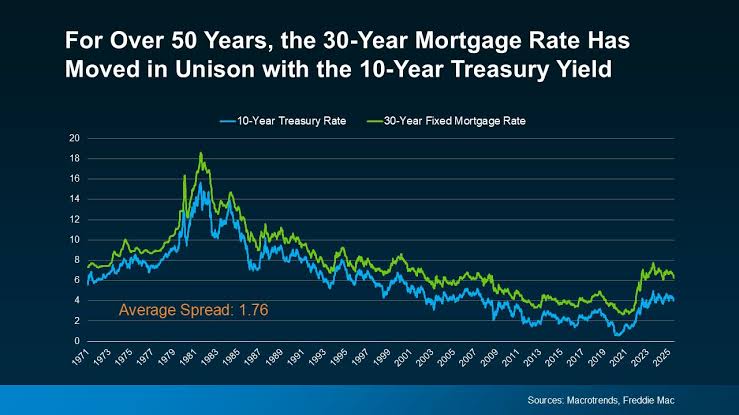
Mortgage rates track the 10-year yield more closely than they follow the Fed’s own rate. Fixed-rate home loans have followed yields up.
The figures vary by survey. Freddie Mac’s weekly average for a 30-year fixed loan was 7.28%, up a quarter point on the week, according to The Mortgage Reports. Bankrate’s survey of lenders put the 30-year average at 7.38% on 1 October, up from 7.08% a week earlier. That was its highest since May 2024. Bankrate’s live page on Monday showed 7.49% for 30-year fixed loans and 6.78% for 15-year loans.
Those numbers are not directly comparable, because each survey samples lenders differently. Taken together, they show borrowers paying noticeably more than they did a month ago.
For a household, the effect is easy to see. A quarter-point rise on a 30-year loan adds to the monthly payment for the life of the mortgage. It can also decide whether a buyer qualifies at all. Anyone with a variable-rate loan, a home equity line or a credit card faces a different problem. Citizens Bank notes that those costs rise right away after a Fed hike, while existing fixed-rate loans are unaffected.
Savers get a small offset. The same bank says high-yield deposit accounts may pay slightly more.
Why stocks aren’t flinching
Investors have so far looked past the bond move. Monday’s rally was led by large technology companies. CNBC said SpaceX jumped more than 7%. Meta rose almost 2%, Microsoft more than 1%, and Nvidia and Tesla each gained about 2%.
Last week’s jobs report, which came in weaker than expected, helped cool talk of another rate hike this month. CNBC described it as a relief after a week of pressure from rising yields. T. Rowe Price said US indexes ended that week mixed, with investors weighing the jobs data against high yields, volatile oil and uncertainty over the US-Iran conflict.
The services sector is still growing. The Institute for Supply Management’s services index was 54.9 in September, roughly in line with forecasts but slightly lower than the month before, according to CNBC. A reading above 50 signals expansion.
The week ahead
Attention turns to the minutes of the Fed’s September meeting, due Wednesday. They could show how divided officials were about the hike and how likely a second one is. A Newsquawk calendar also lists speeches from several Fed and European Central Bank officials this week, and US consumer sentiment data on Friday.
Oil is a second pressure point. Brent crude settled down 1.89% at $100.32 a barrel on Monday, CNBC said. Whether oil prices ease will matter for inflation, and so for yields and mortgage rates. U.S. News notes that mortgage rates have tended to rise whenever the Iran conflict flares and ease when it looks closer to resolution.
If yields stay near 5.3%, ordinary borrowers will keep feeling it long after the stock-market headlines fade. Whether the Nasdaq’s record run can survive that is not yet clear.