Blast is the worst fungal disease of cereals, according to a researcher who studies it. A team led from the UK now reports a possible way to make wheat, barley and rice better at fighting it.
The work comes from the John Innes Centre, working with colleagues at Kobe University in Japan. As described in a John Innes Centre release carried by ScienceDaily on 15 October 2026, the team studied a recently discovered group of plant immune receptors. They worked out how these proteins recognise an invading pathogen, then showed the proteins can be modified to detect several fungal threats.
What the receptors do
Plants have no antibodies. They rely instead on receptor proteins that spot molecules released by invading microbes. These molecules, called effectors, are tools the fungus uses to weaken a plant’s defences. If a receptor recognises an effector, the plant can mount a response.
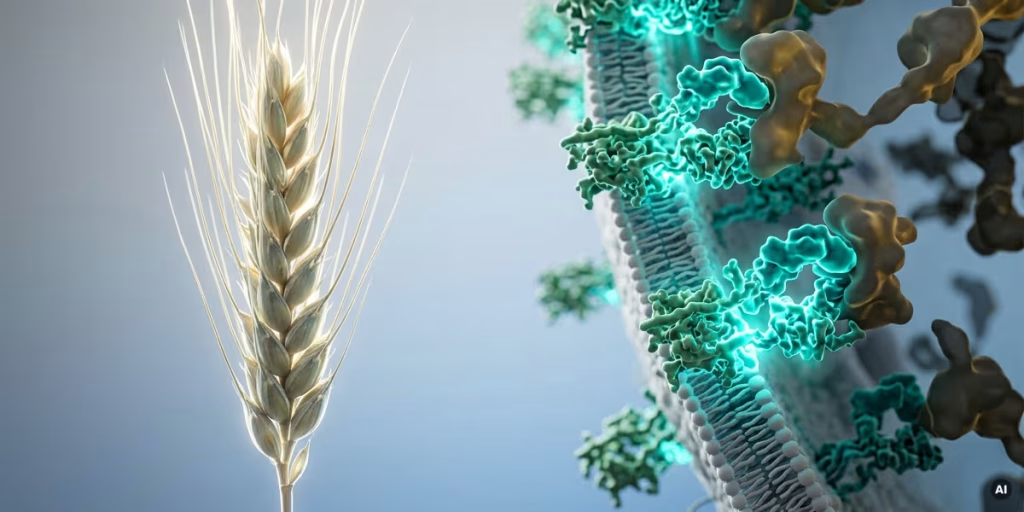
The receptors in this study are known as tandem kinase receptors. According to Technology Networks, the researchers showed at the molecular level how these receptors recognise blast fungus effectors and so limit attacks by the pathogen.
They then went a step further. The team engineered the receptors so they could detect effectors from infections of both wheat and barley. That, the report says, opens a path to broader and more durable resistance in cereals.
Why blast matters
Blast is caused by the fungus Magnaporthe oryzae. An earlier report from the same research partnership, published in 2024 and covered by Phys.org, said the rice form of the disease is directly responsible for the loss of more than 30% of the rice harvest each year. The same pathogen can also infect wheat and barley.
The release frames the finding against a wider concern: a global food supply that is increasingly threatened by spreading infections and climate change.
Professor Mark Banfield, a group leader at the John Innes Centre and an author of the study, said the team had found something that could lead to a potential intervention against what he called the worst fungal disease of cereals.
A second route to the same goal
This is not the group’s first attempt at redesigning a plant’s defences. In 2024, the UK and Japan collaboration reported in Proceedings of the National Academy of Sciences that they had modified a different type of immune receptor from rice, known as an NLR. They engineered it to bind a broader, conserved family of blast fungus effectors. Banfield described that result as a proof of principle for delivering robust resistance.
The new study looks at a different receptor class. Both approaches share a logic. Natural receptors tend to recognise only specific effectors, and a fungus can evolve to escape them. If a receptor can be reshaped to recognise more effectors, or a conserved one the fungus cannot easily drop, resistance may last longer.
What is still unknown
The sources describe laboratory-level research on how the receptors work and how they can be redesigned. They do not report field trials or tests in finished crop varieties. The release says the work could “eventually” lead to crops with strong, long-lasting resistance, which signals that practical use is some way off.
Several questions remain open. It is not yet known how well engineered receptors would perform in a growing plant under farm conditions, or whether blast fungus could evolve around them. Whether such crops could be developed and approved for planting is also unanswered. Rules on gene-edited and engineered crops vary widely between countries, and that will shape how any such approach reaches farmers.
For now, the study adds a mechanism to the toolkit. It explains how one class of receptors recognises a major crop pathogen, and it shows the recognition can be broadened by design. That is the groundwork breeders and biotechnologists would need before testing the idea in real crops.