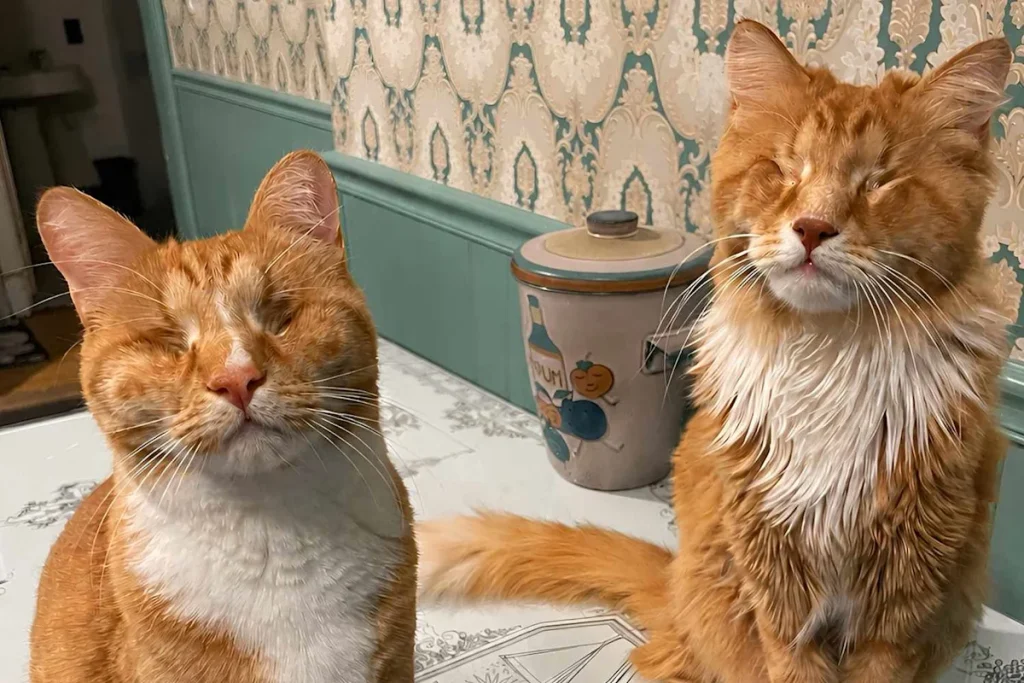
Two brothers named Gary and Shaggy stood out as kittens for one reason: their legs were unusually long. Years later, they have become the first domestic cats with a genetically confirmed case of Marfan syndrome, a connective tissue disorder known mainly in people.
The work comes from researchers at Cornell University and was published in Scientific Reports, according to Cornell’s summary of the study. The paper describes what the authors call the first molecular characterization of the condition in domestic cats.
What the vets found
As the cats grew, veterinarians found abnormalities in the structure of their eyes and an enlarged aorta, the body’s main artery. Together with the long limbs, those signs pointed toward Marfan syndrome, an inherited condition that weakens connective tissue throughout the body.
In people, the disorder affects roughly 1 in 4,000. Doctors diagnose it from a displaced lens in the eye and severe widening of the aorta, or from a mutation in the FBN1 gene, as described by the trade publication Rheumatology Republic. Both cats, adopted from a shelter, showed those two cardinal features.
Whole genome sequencing then found a mutation in FBN1.
A gene that was weakened, not switched off
FBN1 carries the instructions for fibrillin-1, a protein that helps build connective tissue in blood vessels, bones, ligaments, skin and eyes. According to Cornell, as relayed by the Finger Lakes outlet FingerLakes1, each brother carried two altered copies of the gene, one from each parent.
That is unusual. In humans, a single altered copy of FBN1 can be enough to cause Marfan syndrome. Having two altered copies is extremely rare and can interfere with the body’s ability to make normal fibrillin-1.
The variant in Gary and Shaggy did not shut the gene down completely. It only partly disrupted it. The Cornell summary says that is why the cats survived into adulthood, since some normal function remained. The paper’s title describes the change as a homozygous hypomorphic splice-region variant, meaning both copies carry a change near a splice site that reduces, rather than eliminates, the gene’s output.
The sources do not say what happened to the cats’ health after diagnosis, and this article does not speculate on it.
Who did the work
The team combined detailed clinical examinations with genetic sequencing. Cornell specialists worked with collaborators at Ghent University in Belgium, the University of Pennsylvania and the Schwarzman Animal Medical Center in New York City.
The senior author is Dr. Jacquelyn Evans, an assistant professor at Cornell’s College of Veterinary Medicine and Baker Institute for Animal Health. She said the findings “provide a foundation for improved veterinary diagnostics,” according to the Cornell release.
News-Medical, summarizing the same release, reports that the case could help veterinarians recognize similar cases in future and may help in developing genetic tests for cats.
Why it matters
This is a two-animal case report, not a population study. It does not show how common the condition is in cats, and the sources do not claim that. What it does is give vets a defined set of signs to look for: long limbs, lens problems in the eye and a dilated aorta, backed by a specific gene change.
It also offers a possible new animal comparison for a human disease. The sources do not say whether the cats will be used for research on treatments, and no such plan has been announced in the material reviewed.
The study was published in the September 19 issue of Scientific Reports. Cornell’s public release circulated more widely this week.
The paper is Cook, S. R., et al., “A homozygous hypomorphic FBN1 splice region variant in domestic cats with Marfan syndrome.”