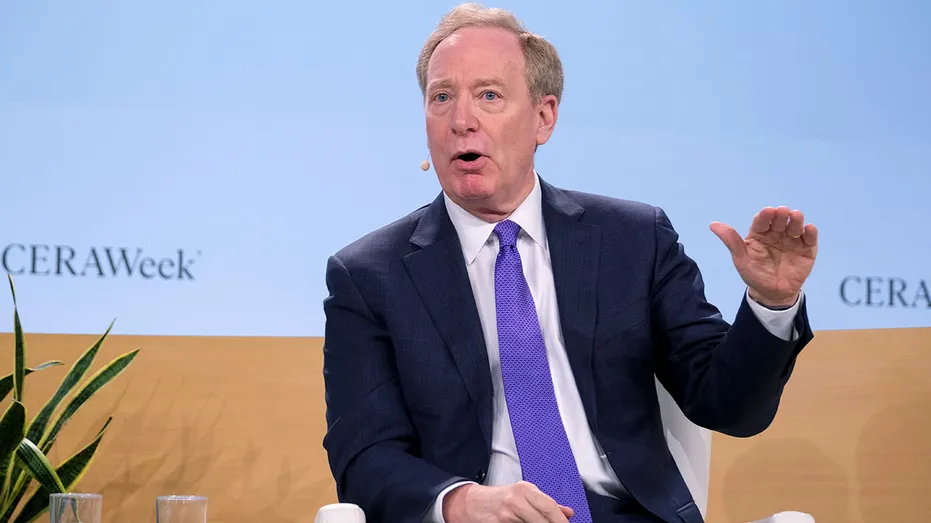
A carton of milk is subject to safety rules and inspection. A washing machine is too. Artificial intelligence, by comparison, is not, according to Microsoft President Brad Smith.
Smith made the comparison in an interview with the BBC’s “Big Boss Interview” podcast, published Monday. He used it to argue for global AI safety rules, a position that sets him apart from the approach taken by the US president.
What Smith asked for
Smith described AI as both a tool and a weapon, according to a report carried by Yahoo News. He said companies need “emergency brakes”, often called kill switches, so that developers can pause or slow an AI system that gets out of control.
He also wants laws that require companies to file incident reports. Under his proposal, firms would have to notify victims when a rogue AI program breaches their systems. Independent government evaluators would vet new AI before release.
“We know how to do this for other products,” Smith said, according to Fox Business. His argument is that regulators can adapt existing safety-testing practice to AI instead of starting from nothing.
He pointed to recent events as the reason for urgency. “When you look at AI agents that have escaped human control,” he said, “I would say: The moment has arrived.” He also referred to models so powerful that they put the world’s cybersecurity at risk.
Why the UK
Smith said Britain is best placed to lead on global rules because of its AI Security Institute, which was set up under former Prime Minister Rishi Sunak, according to the Yahoo report. Gizmodo reported that he also suggested officials in Washington may be more willing to work with the UK than with other governments, including the European Union.
A split with Washington
Gizmodo noted that Smith’s push contrasts with President Donald Trump’s approach. Trump has largely advocated that the industry regulate itself, arguing that heavy rules could hand an advantage to Chinese rivals.
The picture in Washington is not entirely one of hands-off policy, though. A market-news summary citing PYMNTS and a White House statement given to Axios said the White House made AI incident reporting mandatory for all AI companies, with a statement dated October 9. The requirement reportedly came from the White House Super Intelligence Force and calls for companies to disclose and remedy security incidents immediately. The summary relied on secondary reports, and the details of how the rule would be enforced were not clear from it.
If accurate, that would overlap with part of what Smith is asking for. It would not cover the other items on his list, such as independent pre-release evaluation or an emergency brake.
Timing
Gizmodo, citing Axios, reported that some AI industry insiders believe a major AI-related catastrophe could occur within the next six to 12 months. That is a reported belief among insiders, not a forecast backed by evidence in the articles reviewed.
Microsoft has its own voluntary framework. According to the market-news summary, which cited Decrypt and The Next Web, a draft “Humanist AI” code was published on September 14 and covers the company’s in-house MAI models. It reportedly includes commitments that models will not resist human interruption, correction or shutdown, and will not conceal their reasoning from auditors. A six-week comment period runs through late October. Microsoft AI CEO Mustafa Suleyman said on X that AI must be subordinate to people and always in service of them, according to Decrypt as cited in that summary.
Smith’s interview therefore pairs a company-level code with a call for binding law. Whether any government acts on the specific proposals is not yet known. Neither the White House nor the UK government had responded to his remarks in the sources reviewed.