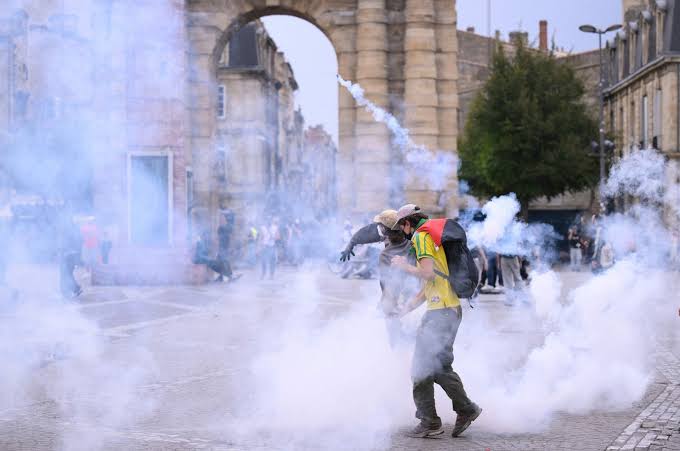
A 15-year-old boy lost a hand in the northern city of Lens this week after police fired a stun grenade during a clash with riot police. The French government has now paused the use of those weapons against student demonstrators. The protests behind the clash have gone on for more than two weeks and show no sign of ending.
According to Reuters, the government announced on Wednesday that it was pausing stun grenades in its policing of student protests.
Interior Minister Laurent Nuñez said on RTL radio that the suspension would last until the facts of the incident were clarified.
A pause, not a ban
The wording matters. The suspension covers high school student protests and is temporary, tied to the outcome of the inquiry into what happened in Lens. It does not rule out their use elsewhere.
Amnesty International France called the move
“an important and welcome first step”
but wants more. In its statement, the group’s president, Anne Savinel-Barras, said the devices should be permanently banned from the policing of all protests. Amnesty noted that the weapon has already caused numerous serious injuries in France, particularly during the crackdown on the Yellow Vests movement.
Rights groups, students and some political opponents have accused police of disproportionate force, Reuters reported. The government has rejected the idea that officers were told to go after teenagers.
What the students want
The demonstrations began over conditions in schools.
Reuters described Lyon protesters voicing anger over overcrowded classrooms, teacher shortages and dilapidated buildings,
which students blame on years of underinvestment.
RTE reported that more than 500 schools were closed on one day after demonstrations swept across the country.
The movement has also fed wider public anger
six months before an election to replace President Emmanuel Macron.
France 24 reported that the push has produced a large number of arrests. One of its headlines put the total at more than 6,000 since the demonstrations began. I could not confirm that figure from the underlying reporting, so treat it with caution.
The prime minister’s answer
Prime Minister Sébastien Lecornu went on television Wednesday evening.
France 24 reported that he said security forces had not been instructed to crack down on teenage protesters,
and that his government would present measures on student grievances by the end of the month.
Earlier in the week he had told lawmakers that high schools would replace some lessons with a
“period of internal democracy”
to air grievances. CNN reported that he condemned violence at the margins of the protests, which were mostly peaceful on Tuesday.
On Thursday, France 24 reported, Lecornu detailed steps announced by the education minister. They include deploying the 3,024 supply teachers who currently have no classes, with priority for the 114 secondary schools in the greatest difficulty. He also said the government would table amendments to the 2027 budget to turn some pupils’ proposals into concrete measures.
He ruled out extra spending beyond what is already planned. According to Le Monde, as relayed by StratNews Global, the government is relying on a proposed €64 billion education budget, an increase of €1.2 billion. France is under pressure over public debt and rising fuel prices, and Lecornu leads a government without a parliamentary majority. He appealed to lawmakers for a budget compromise. Reports differ on the timing: one account puts the start of budget talks on 13 October, while CNN reported a parliamentary debate on 12 November.
Unconvinced
Student groups were not satisfied. Les Lycéens spokesperson Anaïs Ella told CNN that Lecornu did not address the demands set out by student unions. Union leaders asked for a meeting with the prime minister, saying they have costed proposals to present. One leader, Ryad Rani, urged students to stay mobilised and said the balance of power was on their side.
In Nantes, a 17-year-old identified as Camille told AFP:
“We don’t want words, we want action.”
Students in Rennes also said they were disappointed. Teacher unions have called for new nationwide strikes.
The protests have also produced other incidents. France 24 reported that an investigation was opened after a 17-year-old suffered a head injury outside a secondary school in Marseille. Separately, it said France summoned Iran’s ambassador over what it called a disinformation campaign about the protests.
The government now faces two tests. One is whether the Lens inquiry produces findings that extend the suspension or lead to a broader ban. The other is whether the plan due by the end of October offers enough to students without breaching budget limits. For now, unions have promised more marches.