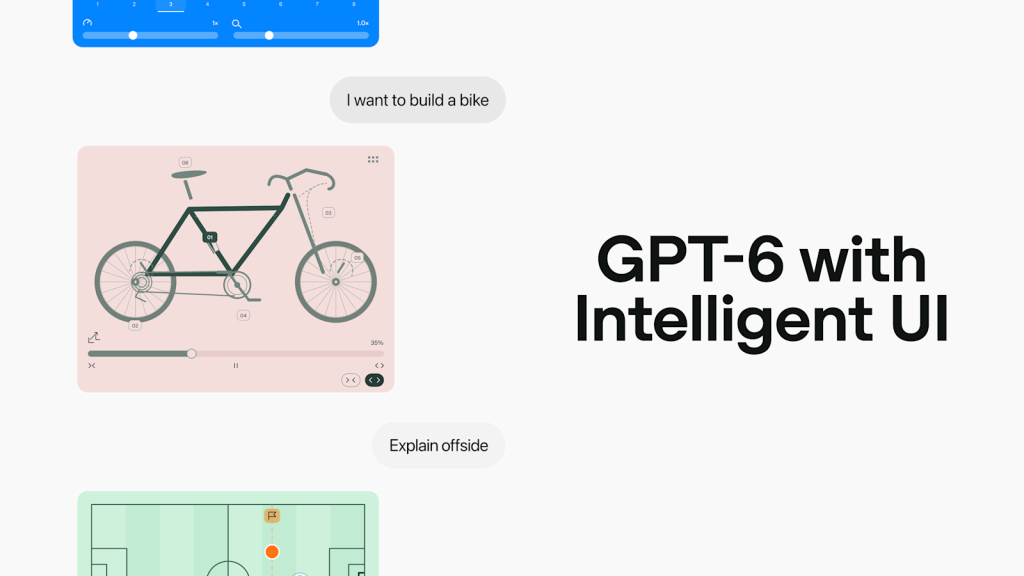
Ask ChatGPT to split a dinner bill and you may now get a working calculator instead of a paragraph of arithmetic. That is the most visible change in OpenAI’s GPT-6 rollout, which began on 7 October.
The company calls the feature Intelligent UI.
GPT-6 can compose a response from text, visuals and interactive elements, choosing how they fit together based on the question.
Responses can include graphics, charts, tappable buttons, forms and other interactive experiences that work inside the conversation.
What users will see
According to OpenAI’s announcement, the format depends on the question.
A comparison might appear side by side, while an explanation might become an interactive diagram.
When plain text is the most useful answer, ChatGPT can still give plain text.
TechRepublic describes some examples.
Users could adjust savings contributions, explore a diagram or change the stops on a trip map without asking for a whole new response.
The gHacks report lists similar cases:
a recipe with its cooking timeline beside it, road trip stops placed on a map, and small tools such as a savings calculator, a bill splitter or a game played inside the chat.
No special prompt is needed.
Users can still ask ChatGPT to build a tool for a particular task.
Who gets it, and when
The rollout began in the Chat tab for Plus, Pro, Business and Enterprise users, and extends to Free and Go users from the following day.
TechRepublic gives that start date as 8 October.
The model lineup is a little tangled. According to Search Engine Journal,
GPT-6 replaces the “Latest” option in the model menu, while GPT-5.6 Sol stays available as a separate option.
The same report says
the Pro thinking level continues to run on GPT-6 Astra and does not support Intelligent UI.
Older ChatGPT desktop apps are also left out.
gHacks adds that
paid tiers get GPT-6 Sol, while Free and Go users get GPT-6 Luna, both described by OpenAI as tuned for everyday conversation.
The gHacks piece uses the “GPT-6 Sol” name, while Search Engine Journal refers to “GPT-5.6 Sol”. This article could not reconcile the two from the sources.
Intelligent UI is being introduced gradually on the web and in updated apps. It works
at thinking levels from Instant to Extra High.
Speed and scale
One further change is about speed. Search Engine Journal reports that
ChatGPT can start answering before it finishes thinking, including on web search questions.
The audience is large. gHacks says
the release targets the more than 1.2 billion people who use ChatGPT each week, according to the company.
That figure comes from OpenAI and was not independently verified in the sources reviewed.
What remains unclear
The sources are mostly OpenAI’s own materials and trade-press summaries of them. They contain no independent testing of how reliable the interactive tools are. They also don’t say whether the calculators and forms produce accurate results, or how often ChatGPT picks a visual format when plain text would do.
The rollout is also staggered by plan, app version and thinking level. What a given user sees may differ for some days.
The release shifts ChatGPT further from a text box toward something closer to an app builder. Whether people want a savings calculator generated mid-chat is a question for usage data, which OpenAI has not published.