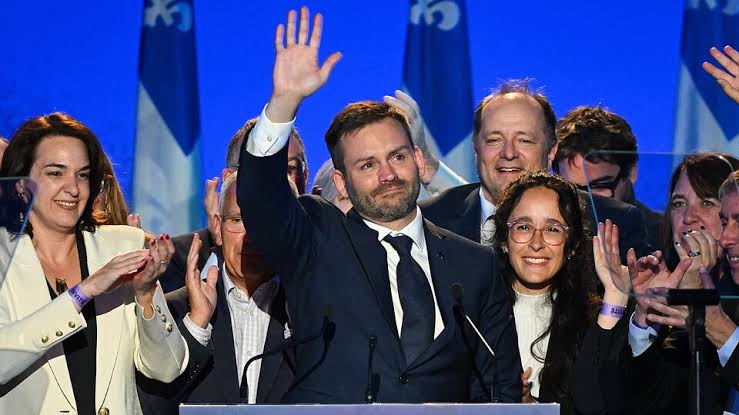
Four years ago the Parti Québécois held three seats in Quebec’s National Assembly. On Monday night it won 59 and the right to form the next government.
The result, reported by CBC News, the Globe and Mail and BNN Bloomberg, makes Paul St-Pierre Plamondon the province’s next premier. It is a minority mandate. The 125-seat legislature requires 64 seats for a majority, and the PQ finished five short.
A government elected on a thin vote
According to the Globe and Mail, the PQ took about 28 per cent of the vote, the lowest share for any winning party in Quebec’s history. CBC reported that the party’s win owed much to voter fatigue after eight years of Coalition Avenir Québec (CAQ) rule.
The CAQ was hit hard. Premier Christine Fréchette lost her own seat, CBC reported, and in her concession speech she took responsibility for the party’s fall. BNN Bloomberg reported that she is resigning as CAQ leader. The Globe described the party as facing extinction.
The Quebec Liberals remain the official opposition for the third election in a row. They more than doubled their seats to 40, according to BNN Bloomberg. Leader Charles Milliard won his riding of Orford. Conservative leader Éric Duhaime won in Bellechasse, which the outlets describe as the first time Conservatives have been elected in modern Quebec history. Québec solidaire co-leader Ruba Ghazal was projected to hold Mercier.
The referendum question
St-Pierre Plamondon won the PQ leadership in 2020 on a promise to hold a vote on independence. In his victory speech he said he still dreams of making Quebec a country. The Globe quoted him calling independence a “question of survival.”
The Globe reported that he has promised a referendum within a first mandate, though not before US President Donald Trump leaves office in 2029. That timeline leaves room for a second election first.
A minority makes it harder. According to the Globe, the PQ would need opposition support to adopt a referendum question in the National Assembly. The Liberals and Conservatives have said they will not provide it. Milliard rejected any talk of a referendum outright, CBC reported, saying “No way.”
Québec solidaire, which also backs sovereignty, has not said clearly whether it would help, the Globe reported. BNN Bloomberg noted that the left-leaning party could be a possible partner for the PQ’s plans. One analyst quoted by the outlet argued that the referendum pursuit cost the PQ a majority. That is one interpretation, and the sources do not show it is shared by all observers.
Relations with Ottawa
In his speech, the premier-designate promised to work with other parties and to be “direct and transparent” with Prime Minister Mark Carney, CBC reported. CBC described this as setting the stage for a tense relationship with Ottawa. A Quebec referendum has not been on the federal agenda for more than a decade.
St-Pierre Plamondon also addressed English-speaking Quebecers in English. He said he would be premier of everyone in the province and that “we share the same future,” according to CBC.
The PQ also took the Papineau riding, which the party had not won since 1976. Voters in the regions had named the economy, language and health care as their main concerns before the vote, CBC reported.
The new government will have to show it can pass budgets and legislation with only about a third of the seats’ worth of cushion it would need for a majority. Whether it can do that with Liberal, Conservative or solidaire votes has not yet been tested.